



Spiral Dental Implants: Design, Indications and Clinical Use
Updated Jul 20, 2026
International shipping from Israel depends on the SKU, destination and service. Stock, price, charge and timing are confirmed at checkout; no local store, warehouse, inventory or pickup.
Where bone density is low — the posterior maxilla above all — primary stability is the variable an implant team designs its whole protocol around. Spiral dental implants answer it at the level of macro-geometry: a tapered body carrying a self-tapping, condensing thread that compacts bone as the fixture advances instead of cutting it away. This guide explains how the design works, why it matters in soft bone and immediate-load workflows, and how the Load-Now® spiral implant — the flagship of the Dental Solutions spiral implants range — is specified, compared with cylindrical and one-piece alternatives, and restored on the Internal Hex platform.
This guide is written for licensed dental professionals — implantologists, oral surgeons, implant clinics and labs. It describes product design and planning considerations only. Always follow the instructions for use (IFU) and your own clinical judgment.
What is a spiral dental implant?
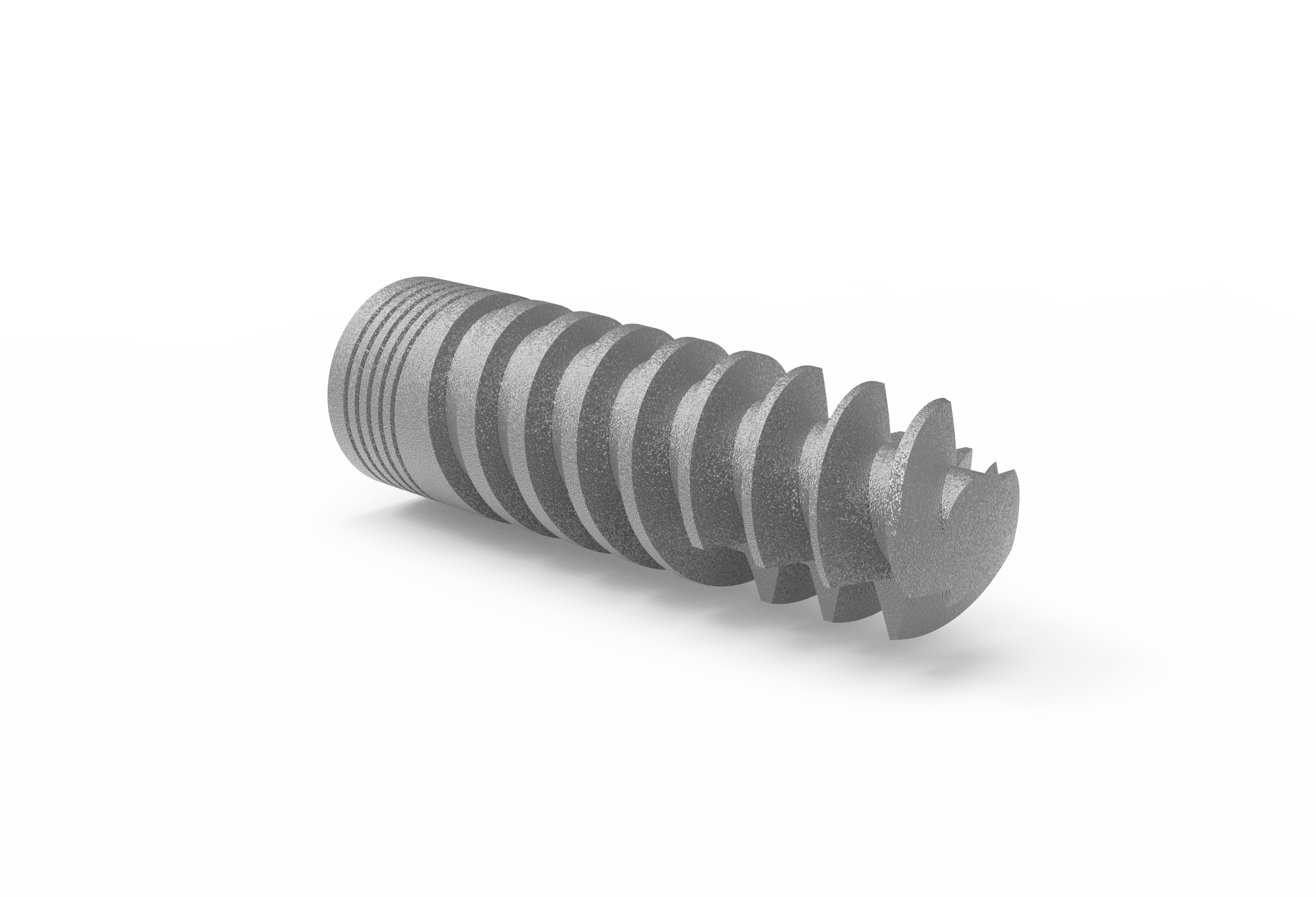
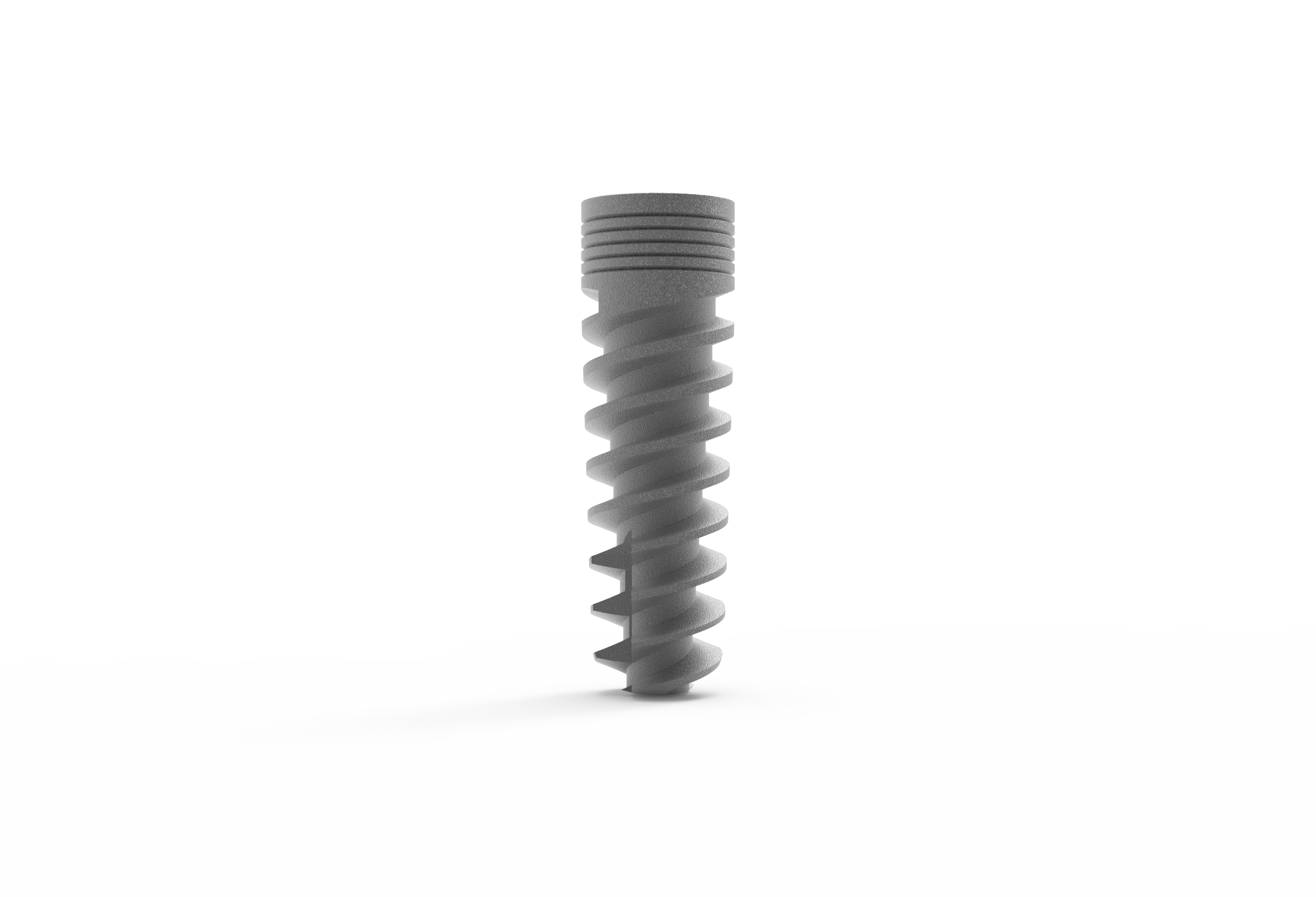
A spiral dental implant is a root-form fixture defined by two features: a tapered core and a continuous self-tapping thread with a condensing profile. During insertion the thread does two jobs at once. Its cutting edges let the implant advance through an osteotomy prepared according to the IFU without a separate tapping step, and its condensing profile displaces trabecular bone laterally, compacting it against the implant surface rather than excavating it. The result is progressive mechanical engagement along the whole body — the property the surgeon reads as insertion torque and primary stability.
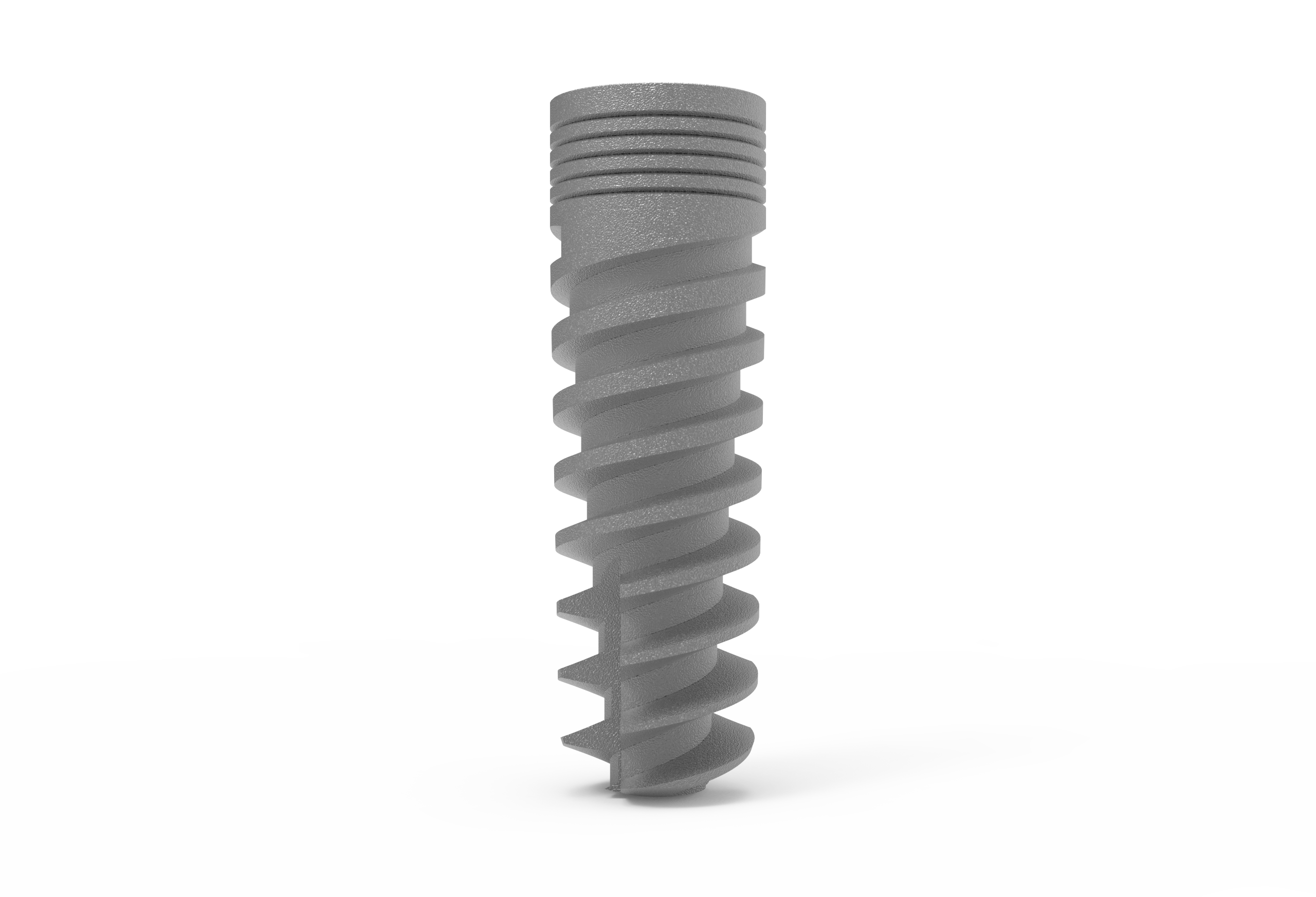
The design family is closely associated with Israeli implant manufacturing — background we cover in our guide to Israeli dental implants. At Dental Solutions the family includes the Load-Now®, our flagship spiral fixture, and the 3-S Sinus Stopper®, a short spiral implant adapted for controlled shallow placement near the sinus floor.
Thread geometry and primary stability in soft bone
Primary stability is purely mechanical: the rigidity of the implant–bone interface at the moment of placement, before any biological integration has taken place. Three groups of factors govern it — the density and architecture of the host bone, the osteotomy protocol, and the macro-geometry of the fixture itself. Thread design is the lever the implant contributes, and it is where spiral designs differ most from parallel-walled fixtures.
- Condensing rather than cutting. A condensing thread compacts trabecular bone laterally as the implant advances. In low-density bone, where a conventional thread may strip rather than grip, that lateral compaction increases the bone-to-implant contact available at placement.
- Taper as progressive compression. A tapered core engages the osteotomy walls progressively: seating the implant increases radial compression toward the crest, which the surgeon perceives as rising insertion torque.
- Self-tapping flutes. Cutting flutes let the fixture cut its own path within the prepared site — following the drilling sequence defined in the IFU — and give the operator a degree of directional control while seating.
- Bone-density dependence. In dense cortical bone condensation is less needed and torque must be managed; in soft bone it is precisely the property sought. Matching site preparation to density remains a clinical decision.
Immediate load: what the Load-Now® design is built for
Immediate-load protocols — restoring an implant with a provisional or definitive prosthesis shortly after placement rather than after a submerged healing phase — stand or fall on primary stability. That is why immediate-load workflows are so closely associated with the self-tapping spiral implant: the geometry is engineered to maximize the mechanical stability available on the day of surgery. The Load-Now® name states the intent — a spiral implant for cases where the clinician judges the achieved stability sufficient to load early, whether for a single provisional crown or a splinted full-arch restoration on multi-unit abutments.
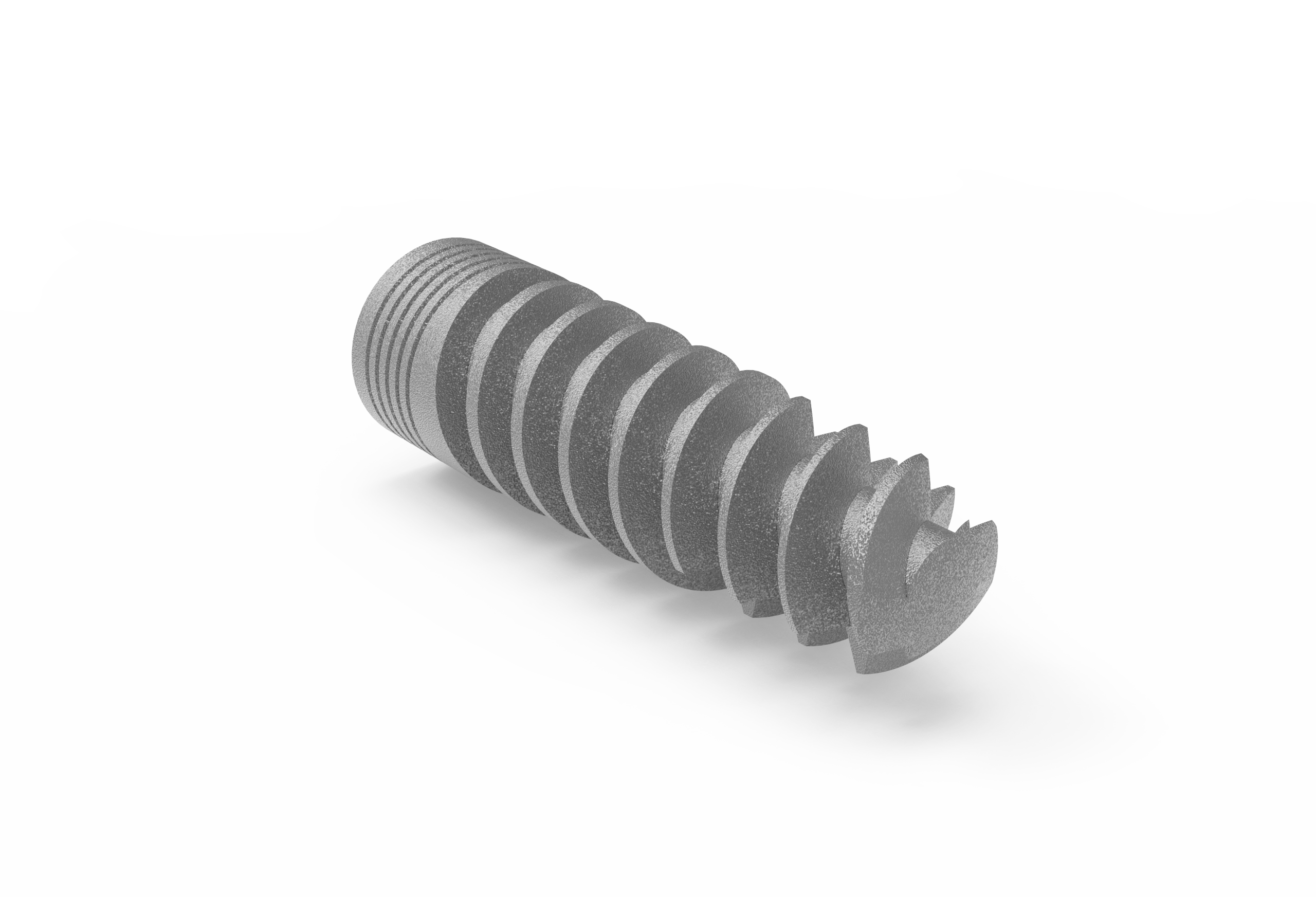
Whether a specific case is loaded immediately is never a product property: it is a case-by-case decision by the treating clinician, based on achieved stability, occlusion, parafunction and the restorative plan, within the IFU.
Spiral, cylindrical or one-piece: the catalog compared
Spiral geometry is one answer among several. The table below compares the five implant designs in the Dental Solutions catalog — all titanium grade 5 (Ti-6Al-4V ELI); verify the product-specific regulatory documentation.
| Implant | Body design | Diameters | Lengths | From (USD) |
|---|---|---|---|---|
| Load-Now® spiral | Tapered, self-tapping condensing thread; two-piece, Internal Hex | Ø3.0–Ø6.0 mm (6 options) | 6–16 mm (6 options) | $26.40 |
| Dual-Bone® cylindrical | Cylindrical (parallel-walled) body; two-piece, Internal Hex 2.42 | Ø3.5–Ø6.0 mm | 6–16 mm | $24.50 |
| 3-S Sinus Stopper® | Short spiral body with wide coronal stopper; Internal Hex 2.42 | Ø4.2 / Ø5.0 mm | 6 / 7 / 8 mm | $44.00 |
| Bendable® one-piece | One-piece implant with bendable neck, for immediate-load protocols | Ø3.5–Ø5.5 mm | 6–20 mm | $44.00 |
| O-Ball Mini® one-piece set | One-piece mini implant with O-ball head, silicone ring and titanium cap | Ø2.5 mm | 10–15 mm | $68.00 |
In practice the designs complement each other. The Dual-Bone® cylindrical implant covers conventional protocols across bone types; the 3-S — which has a dedicated sinus stopper implant guide of its own — answers reduced bone height under the sinus; the Bendable® one-piece and the O-Ball Mini® serve immediate-load and overdenture-retention niches where a one-piece format is preferred. The full fixture range is in our dental implants catalog.
Load-Now® spiral implant: specification
| Feature | Detail |
|---|---|
| Design | Spiral dental implant — tapered, self-tapping condensing thread, built for immediate-load protocols |
| Connection | Internal Hex 2.42 mm on regular and wide platforms; Internal Hex 2.1 mm on the slim platform |
| Platforms | Slim / Regular / Wide |
| Diameters | Ø3.0, Ø3.5, Ø3.75, Ø4.2, Ø5.0, Ø6.0 mm |
| Lengths | 6.0, 8.0, 10.0, 11.5, 13.0, 16.0 mm |
| Material | Titanium grade 5 (Ti-6Al-4V ELI) |
| Quality | Product-specific regulatory documentation |
| Price | From $26.40 per implant, with automatic quantity discounts |
Internal Hex 2.42 and the prosthetic pathway
Regular- and wide-platform Load-Now® fixtures carry the same Internal Hex 2.42 mm connection as the rest of the Dental Solutions system, so every restorative pathway is open without adapters: titanium healing caps for soft-tissue management; straight, angled and anatomic abutments for cemented work; multi-unit abutments (straight and angled) for screw-retained splinted and full-arch cases; and open- or closed-tray transfers, analogs, scan bodies and Ti-Base interfaces for conventional or digital impressions. One connection across spiral and cylindrical fixtures keeps logistics simple: the prosthetic drawer is standardized while body design is chosen site by site.
When clinicians choose a spiral design
The situations below are where implant teams commonly reach for a spiral fixture — decision inputs, not recommendations; case suitability rests with the treating clinician.
- Soft bone (D3–D4) sites, typically the posterior maxilla, where thread condensation raises the primary stability a site can deliver.
- Immediate-load and immediate-restoration plans, from single units to full arches, where day-of-surgery stability decides whether the protocol can proceed.
- Sites demanding insertion-path control, where self-tapping flutes give the operator directional adjustment during seating.
- Reduced bone height under the sinus, where the short 3-S spiral body with its coronal stopper is the dedicated option — see the sinus stopper implants category.
- Mixed-density arches, where many teams place spiral fixtures in soft posterior bone and cylindrical fixtures elsewhere, keeping one prosthetic platform throughout.
Ordering spiral implants from Dental Solutions
Frequently asked questions
What makes a dental implant “spiral”?
The combination of a tapered core and a continuous self-tapping thread with a condensing profile. The fixture advances by compacting trabecular bone laterally against its surface, building mechanical engagement along the whole body instead of relying on cortical anchorage alone.
Are spiral dental implants suitable for immediate loading?
The geometry is engineered to maximize achievable primary stability — the mechanical precondition of immediate loading, and what the Load-Now® is designed for. Whether a given case is actually loaded early remains a clinical decision based on achieved stability, occlusion and the restorative plan.
What diameters and lengths does the Load-Now® spiral implant come in?
Which prosthetic connection do the spiral implants use?
Regular and wide platforms use Internal Hex 2.42 mm, shared with the whole Dental Solutions prosthetic range — healing caps, abutments, multi-units, transfers, analogs, scan bodies and Ti-Bases. Slim-platform fixtures use the Internal Hex 2.1 mm connection.
Spiral or cylindrical — which should a clinic stock?
Many clinics stock both: spiral fixtures for soft bone and immediate-load plans, and the cylindrical Dual-Bone® for conventional protocols. Because both carry Internal Hex 2.42, the prosthetic components are shared — only the fixture choice changes per site.
For licensed dental professionals only. Product selection, surgical technique and case suitability remain the responsibility of the treating clinician — always follow the IFU.